How Long Does It Take to Learn Chinese? Hours per HSK Level
For an English speaker, Chinese is a long project. The US government's language school plans 88 weeks and 2,200 class hours of full-time training to get its students to a professional level in Mandarin. You don't need that much to pass an HSK exam, though. The early levels are small: HSK 1 is 150 words, and you can work through that list in a few weeks.
The short version: For professional fluency, plan on years, not months. The State Department's figure for Mandarin is 2,200 class hours. At 30 minutes a day, that is about 12 years; at an hour a day, about 6 (our math, and that counts class hours only). The HSK word lists are a more reachable goal. By our estimate, at 30 minutes a day you can work through the HSK 1 list in under a month, HSK 3 in about 2 to 3 months and HSK 4 in about 5. Those are the floor, though, because exams also test listening and reading.
What the FSI says about Mandarin
The State Department trains US diplomats in 60 languages at its National Foreign Affairs Training Center, long known as the Foreign Service Institute (FSI). On its foreign language training page, the State Department sorts languages into four categories by how long its students usually take to reach a score of 3 in speaking and listening on the Interagency Language Roundtable (ILR) scale.
| Category | Examples | Training time |
|---|---|---|
| I: close to English | Spanish, French, Italian, Portuguese | 24 to 30 weeks (552 to 690 class hours) |
| II | German, Indonesian, Swahili | About 36 weeks (828 class hours) |
| III: "hard languages" | Russian, Thai, Vietnamese, Hindi | About 44 weeks (1,012 class hours) |
| IV: "super-hard languages" | Mandarin, Cantonese, Japanese, Korean, Arabic | 88 weeks (2,200 class hours) |
Category IV is described as "languages which are exceptionally difficult for native English speakers." Mandarin takes about three times as long as Spanish (2,200 class hours against 690).
What does an ILR 3 mean? The ILR speaking scale calls it "General Professional Proficiency": you can take part effectively in most formal and informal conversations on practical, social and professional topics. That is a high bar, well past ordering food or chatting with a tutor.
Keep three things in mind before you use this number:
- It is full-time study. The State Department says a typical week is 23 hours in class and 17 hours of self-study.
- It is class hours. The 2,200 hours do not include that self-study time.
- It varies. The page says actual time depends on "the language learner's natural ability, prior language-learning experience, and time spent in the classroom."
What 2,200 hours means at 30 or 60 minutes a day
This is our own math from the FSI figure, not an FSI number:
| Daily study | Days to reach 2,200 hours | Roughly |
|---|---|---|
| 30 minutes | 4,400 | 12 years |
| 60 minutes | 2,200 | 6 years |
| 2 hours | 1,100 | 3 years |
That looks discouraging, but most learners are not aiming for diplomatic-level Chinese. If your goal is to read signs, hold simple conversations or pass HSK 3 or 4, the HSK word lists give you a much closer target.
How many words each HSK level needs
CTI, the organization that runs the HSK, does not publish official study hours per level. It publishes word counts. These are cumulative: HSK 3 includes the words from HSK 1 and 2.
| Level | HSK 2.0 words | HSK 3.0 words |
|---|---|---|
| HSK 1 | 150 | 300 |
| HSK 2 | 300 | 500 |
| HSK 3 | 600 | 1,000 |
| HSK 4 | 1,200 | 2,000 |
| HSK 5 | 2,500 | 3,600 |
| HSK 6 | 5,000+ | 5,400 |
| HSK 7 to 9 | (none) | 11,000 |
The HSK 2.0 counts come from CTI's level table. The HSK 3.0 counts are the entries in the vocabulary section of the new HSK syllabus (PDF, in Chinese). The first worldwide HSK 3.0 exam is on December 13, 2026. If you are not sure which list applies to you, read HSK 3.0 vs HSK 2.0 first.
How long each HSK level takes: our estimate
To turn word counts into time, we used a simple pace. These numbers are our assumptions, not official figures:
- 30 minutes a day: 10 new words a day, 6 days a week (60 a week). The rest of the half hour goes to reviewing older words and some listening.
- 60 minutes a day: 20 new words a day, 6 days a week (120 a week), with the same share of review and listening.
- The seventh day is for review only.
Both paces work out to about 3.5 minutes of study time per new word, so the hours are the same either way. Only the calendar changes. All the numbers below are rounded.
| HSK 2.0 | Words | Hours | 30 min a day | 60 min a day |
|---|---|---|---|---|
| HSK 1 | 150 | 9 | 2 to 3 weeks | 1 to 2 weeks |
| HSK 2 | 300 | 18 | 5 weeks | 2 to 3 weeks |
| HSK 3 | 600 | 35 | 10 weeks | 5 weeks |
| HSK 4 | 1,200 | 70 | 5 months | 10 weeks |
| HSK 5 | 2,500 | 145 | 10 months | 5 months |
| HSK 6 | 5,000 | 290 | 19 months | 10 months |
For HSK 3.0, the same pace gives about 4 months at 30 minutes a day for levels 1 to 3 (1,000 words), about 8 months for level 4 (2,000 words) and about 21 months for level 6 (5,400 words). The 11,000 words for levels 7 to 9 would take about 3.5 years at that pace.
Treat these as the floor. They cover getting through each word list, not passing the whole exam. Compare HSK 6 at about 290 hours of vocabulary work with the FSI's 2,200 class hours: most of the time it takes to learn a language goes into listening, reading, speaking and grammar. HSK 3 and up also include a writing section (see CTI's HSK 3 page). So add time for those, plus mock tests before your exam, and expect to need more of it the higher you go.
A sample weekly routine
30 minutes a day
| Day | What to do |
|---|---|
| Monday to Saturday | 10 minutes: 10 new words on flashcards. Say each word out loud before you check it. 10 minutes: go back over the words you missed. 10 minutes: listen to or read something at your level. |
| Sunday | Review only: everything you marked as missed this week, then a short quiz on the week's words. |
60 minutes a day
| Day | What to do |
|---|---|
| Monday to Saturday | 15 minutes: 20 new words. 15 minutes: review the words you missed. 20 minutes: listening and reading (textbook dialogs, graded readers, audio). 10 minutes: speak or write: read a dialog aloud, or write a few sentences with the week's words. |
| Sunday | Review the week's missed words, take a quiz, and from HSK 3 up, do one section of a mock test (CTI's level pages, such as HSK 3, link to them). |
Two habits matter more than the exact minutes:
- Study every day, even briefly. Ten minutes on a busy day still keeps the routine alive.
- Bring back what you miss. Many new words won't stick the first time. Mark them and see them again later that week.
Where HSK Flashcard fits
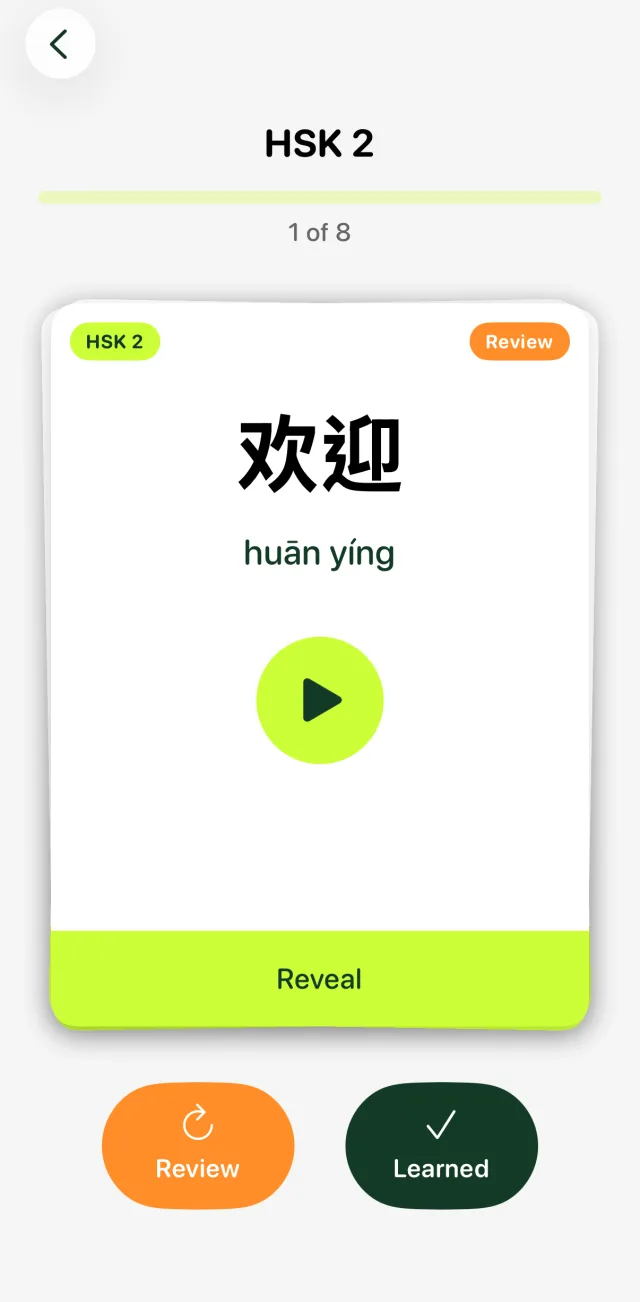
The vocabulary part of this plan is what HSK Flashcard is built for. It follows the HSK 2.0 lists (HSK 1 to 6, about 5,000 words). Each card shows the characters and pinyin, such as 欢迎 (huān yíng, welcome), and a speaker button reads the word aloud with the iPhone's Mandarin voice. Try to recall the meaning, tap Reveal to check, then swipe right if you knew it or left to put it in your Review pile.
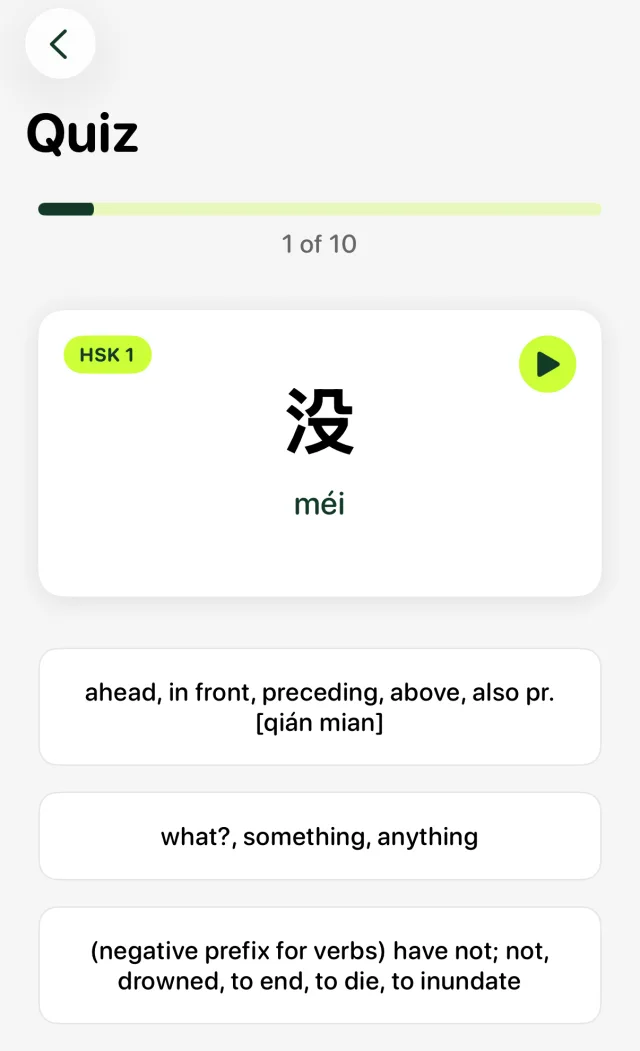
For the Sunday part of the routine, a quiz gives you 10 multiple-choice questions from the words you have learned.
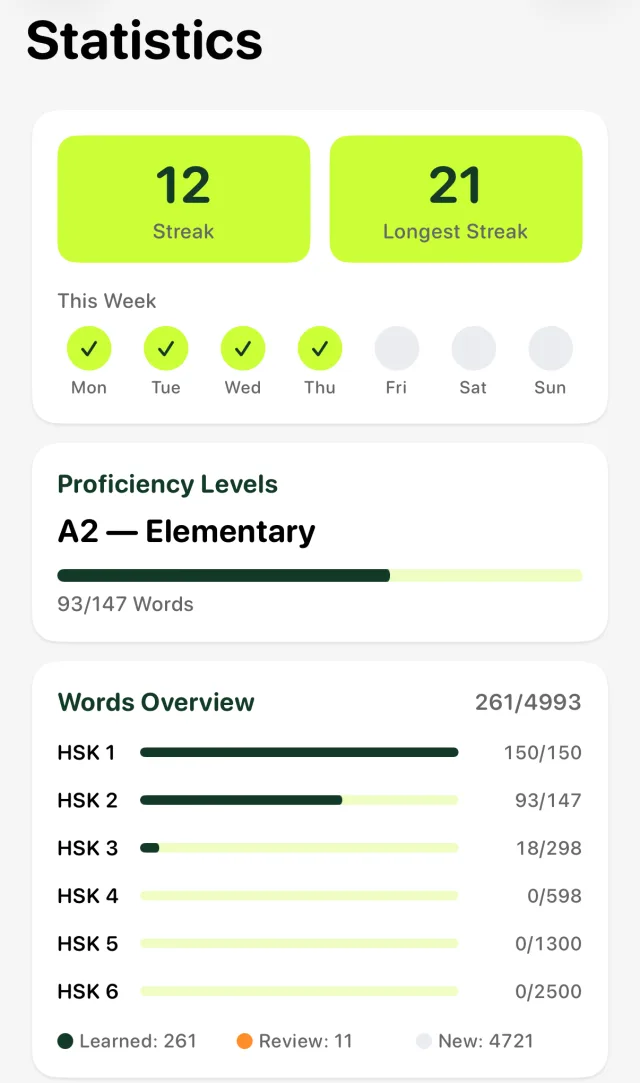
A daily streak and a reminder at a time you choose help with the "every day" habit. The app is free to start.

HSK Flashcard: learn Chinese vocabulary
Study the HSK 1 to 6 word lists with swipeable flashcards that show pinyin and meaning and read each word aloud. Review the words you mark, take quick quizzes, and keep a daily streak. Free to start.

FAQ
Can I learn Chinese in a year?
You can get through a lot in a year. By our estimate above, an hour a day is enough to cover the HSK 2.0 word lists up to HSK 5 in about 5 months, or HSK 6 in about 10. Professional fluency is another matter: the FSI plans 88 weeks of full-time training for that.
Is one hour a day enough to learn Chinese?
It is enough to make steady progress. By our math it takes about 6 years of daily hours to match the FSI's 2,200 class hours, but an hour a day gets you through the early HSK word lists in weeks, not years.
Is Mandarin the hardest language for English speakers?
The FSI puts it in its hardest group, Category IV, together with Cantonese, Japanese, Korean and Arabic. All five get the same 88 weeks of training.
How many hours does it take to pass HSK 1?
CTI does not give an official number. HSK 1 (HSK 2.0) has 150 words, which is about 9 hours of flashcard work at our pace, plus time for the listening and reading practice the exam tests. The current HSK 1 exam is 40 questions and you need 120 of 200 points to pass (CTI's HSK 1 page).
Do I need to learn characters?
For the HSK, yes: the exam is written in characters. The new HSK 1 syllabus lists 246 characters to recognize. Pinyin helps you learn the sound of each word, and you can hide it in the app once you start reading characters on their own.