HSK 1 Vocabulary List: All 150 Words, Grouped by Topic
HSK 1 has 150 words. Below is the complete official list with pinyin and a short English meaning for each one, grouped by topic so you can learn related words together. After the list there is a two-week plan and a short note on what changes with HSK 3.0.
The short version: The list comes from the official HSK vocabulary file that Chinese Testing International (CTI), the organization that runs the HSK, publishes on chinesetest.cn (an Excel file, in Chinese). It has exactly 150 entries. At about 12 new words a day, you can get through all of them in two weeks, with two days left for review.
Where this list comes from
CTI's file is the 2012 revision of the HSK word lists, with one sheet per level. The HSK 1 sheet is titled "HSK(一级)(150)" and lists the words in characters only, with no pinyin or translations. We copied all 150 entries from that sheet and checked our tables against it with a script: 150 rows, 150 different words, none missing and none added.
A few things to know about the tables:
- The topic groups are our own. The official file lists the words in alphabetical order of their pinyin, with no topics. We grouped them to make them easier to learn. Every word appears once.
- The pinyin comes from CTI's syllabuses. For 145 words we used the vocabulary section of CTI's HSK 1 syllabus (2010 edition, archived copy, in Chinese). Five words were added in the 2012 revision and are not in that syllabus, so their pinyin comes from the new HSK syllabus (PDF, in Chinese). Unstressed syllables are written without a tone mark, as in 爸爸 (bàba).
- The meanings are short English glosses for the most common sense at this level. Many words have more meanings than one table cell can hold.
The full HSK 1 word list (150 words)
Greetings and polite words (7)
| Hanzi | Pinyin | Meaning |
|---|---|---|
| 谢谢 | xièxie | thank you |
| 不客气 | bú kèqi | you're welcome |
| 对不起 | duìbuqǐ | sorry |
| 没关系 | méi guānxi | it doesn't matter |
| 再见 | zàijiàn | goodbye |
| 请 | qǐng | please; to invite |
| 喂 | wèi | hello (on the phone) |
People (18)
| Hanzi | Pinyin | Meaning |
|---|---|---|
| 我 | wǒ | I, me |
| 你 | nǐ | you |
| 他 | tā | he, him |
| 她 | tā | she, her |
| 我们 | wǒmen | we, us |
| 人 | rén | person, people |
| 爸爸 | bàba | dad, father |
| 妈妈 | māma | mom, mother |
| 儿子 | érzi | son |
| 女儿 | nǚ'ér | daughter |
| 朋友 | péngyou | friend |
| 同学 | tóngxué | classmate |
| 老师 | lǎoshī | teacher |
| 学生 | xuésheng | student |
| 医生 | yīshēng | doctor |
| 先生 | xiānsheng | Mr., sir |
| 小姐 | xiǎojiě | Miss, young lady |
| 名字 | míngzi | name |
Question and pointing words (10)
| Hanzi | Pinyin | Meaning |
|---|---|---|
| 谁 | shéi | who |
| 什么 | shénme | what |
| 哪 | nǎ | which |
| 哪儿 | nǎr | where |
| 几 | jǐ | how many (small numbers) |
| 多少 | duōshao | how many, how much |
| 怎么 | zěnme | how |
| 怎么样 | zěnmeyàng | how is it? |
| 这 | zhè | this |
| 那 | nà | that |
Numbers and measure words (16)
| Hanzi | Pinyin | Meaning |
|---|---|---|
| 一 | yī | one |
| 二 | èr | two |
| 三 | sān | three |
| 四 | sì | four |
| 五 | wǔ | five |
| 六 | liù | six |
| 七 | qī | seven |
| 八 | bā | eight |
| 九 | jiǔ | nine |
| 十 | shí | ten |
| 个 | gè | (general measure word) |
| 岁 | suì | years old |
| 本 | běn | (measure word for books) |
| 些 | xiē | some |
| 块 | kuài | yuan (money, spoken) |
| 一点儿 | yìdiǎnr | a little |
Time and dates (14)
| Hanzi | Pinyin | Meaning |
|---|---|---|
| 今天 | jīntiān | today |
| 明天 | míngtiān | tomorrow |
| 昨天 | zuótiān | yesterday |
| 上午 | shàngwǔ | morning |
| 中午 | zhōngwǔ | noon |
| 下午 | xiàwǔ | afternoon |
| 现在 | xiànzài | now |
| 时候 | shíhou | time, when |
| 年 | nián | year |
| 月 | yuè | month |
| 号 | hào | day of the month |
| 星期 | xīngqī | week |
| 点 | diǎn | o'clock |
| 分钟 | fēnzhōng | minute |
Places and directions (12)
| Hanzi | Pinyin | Meaning |
|---|---|---|
| 家 | jiā | home, family |
| 学校 | xuéxiào | school |
| 商店 | shāngdiàn | shop, store |
| 饭店 | fàndiàn | restaurant, hotel |
| 医院 | yīyuàn | hospital |
| 中国 | Zhōngguó | China |
| 北京 | Běijīng | Beijing |
| 上 | shàng | up, on, above |
| 下 | xià | down, below |
| 前面 | qiánmiàn | in front |
| 后面 | hòumiàn | behind |
| 里 | lǐ | inside |
Food and drink (9)
| Hanzi | Pinyin | Meaning |
|---|---|---|
| 吃 | chī | to eat |
| 喝 | hē | to drink |
| 菜 | cài | dish; vegetable |
| 米饭 | mǐfàn | cooked rice |
| 水 | shuǐ | water |
| 茶 | chá | tea |
| 水果 | shuǐguǒ | fruit |
| 苹果 | píngguǒ | apple |
| 杯子 | bēizi | cup, glass |
Things around you (16)
| Hanzi | Pinyin | Meaning |
|---|---|---|
| 东西 | dōngxi | thing, stuff |
| 钱 | qián | money |
| 衣服 | yīfu | clothes |
| 书 | shū | book |
| 字 | zì | character (written) |
| 汉语 | Hànyǔ | Chinese (language) |
| 桌子 | zhuōzi | table, desk |
| 椅子 | yǐzi | chair |
| 电脑 | diànnǎo | computer |
| 电视 | diànshì | TV |
| 电影 | diànyǐng | movie |
| 飞机 | fēijī | airplane |
| 出租车 | chūzūchē | taxi |
| 天气 | tiānqì | weather |
| 猫 | māo | cat |
| 狗 | gǒu | dog |
Everyday actions (24)
| Hanzi | Pinyin | Meaning |
|---|---|---|
| 是 | shì | to be |
| 有 | yǒu | to have; there is |
| 没有 | méiyǒu | not have; did not |
| 在 | zài | to be at; at, in |
| 来 | lái | to come |
| 去 | qù | to go |
| 回 | huí | to go back |
| 坐 | zuò | to sit; to take (a bus) |
| 住 | zhù | to live (somewhere) |
| 开 | kāi | to open; to drive |
| 看 | kàn | to look, watch, read |
| 看见 | kànjiàn | to see |
| 听 | tīng | to listen |
| 说 | shuō | to say, to speak |
| 读 | dú | to read (aloud) |
| 写 | xiě | to write |
| 叫 | jiào | to be called; to call |
| 买 | mǎi | to buy |
| 做 | zuò | to do, to make |
| 学习 | xuéxí | to study |
| 工作 | gōngzuò | to work; job |
| 睡觉 | shuìjiào | to sleep |
| 打电话 | dǎ diànhuà | to make a phone call |
| 下雨 | xià yǔ | to rain |
Feelings and abilities (6)
| Hanzi | Pinyin | Meaning |
|---|---|---|
| 爱 | ài | to love |
| 喜欢 | xǐhuan | to like |
| 想 | xiǎng | to want; to think; to miss |
| 认识 | rènshi | to know (a person) |
| 会 | huì | can (know how to) |
| 能 | néng | can (be able to) |
Describing words (11)
| Hanzi | Pinyin | Meaning |
|---|---|---|
| 好 | hǎo | good |
| 大 | dà | big |
| 小 | xiǎo | small |
| 多 | duō | many, much |
| 少 | shǎo | few, little |
| 冷 | lěng | cold |
| 热 | rè | hot |
| 高兴 | gāoxìng | happy, glad |
| 漂亮 | piàoliang | pretty |
| 很 | hěn | very |
| 太 | tài | too (much) |
Small grammar words (7)
| Hanzi | Pinyin | Meaning |
|---|---|---|
| 不 | bù | not, no |
| 都 | dōu | all, both |
| 和 | hé | and, with |
| 的 | de | (shows possession, like 's) |
| 了 | le | (marks a finished action or change) |
| 吗 | ma | (turns a sentence into a yes-no question) |
| 呢 | ne | (asks "what about...?") |
That is 7 + 18 + 10 + 16 + 14 + 12 + 9 + 16 + 24 + 6 + 11 + 7 = 150 words.
Older HSK 1 lists: six words differ
You may see a slightly different HSK 1 list in older books and apps. CTI's first HSK 1 list, in the 2010 syllabus linked above, also had 150 words. The 2012 revision changed six of them:
- Taken out: 饭馆 (fànguǎn, restaurant), 火车站 (huǒchēzhàn, train station), 日 (rì, day), 零 (líng, zero), 没 (méi, not) and 说话 (shuōhuà, to talk).
- Put in: 饭店 (fàndiàn, restaurant), 号 (hào, day of the month), 说 (shuō, to say), 没有 (méiyǒu, not have), 一点儿 (yìdiǎnr, a little), and 哪儿 (nǎr, where) as its own entry. The 2010 list had it in brackets next to 哪.
Four of the words taken out (火车站, 日, 零 and 说话) are in the 2012 HSK 2 list, so you will meet them soon anyway. HSK Flashcard's HSK 1 deck currently follows the 2010 version, so in the app you will see those six older words instead of the new ones.
A two-week plan for the HSK 1 words
This plan is our suggestion, not an official one. It covers 150 words in 12 study days, about 12 new words a day, with two days for review. Plan on 20 to 30 minutes a day.
| Day | New words |
|---|---|
| 1 | Greetings (7), plus 我, 你, 他, 她, 我们, 人 (13) |
| 2 | The rest of People (12) |
| 3 | Numbers and measure words (16) |
| 4 | Time and dates (14) |
| 5 | Question and pointing words (10) |
| 6 | Places and directions (12) |
| 7 | No new words: review days 1 to 6 |
| 8 | Food and drink, Feelings and abilities (15) |
| 9 | Things around you (16) |
| 10 | Everyday actions, first 12 (是 to 看见) |
| 11 | Everyday actions, last 12 (听 to 下雨) |
| 12 | Describing words, Small grammar words (18) |
| 13 | No new words: review everything you missed |
| 14 | Review, then a practice test |
Each day:
- Learn the new words. Say each one out loud with its tones. Then cover the meaning, look at the characters and try to recall it before you check.
- Go back over the words you missed from earlier days. Missing a word the first time is normal. Seeing it again a day or two later is what makes it stick.
- Use the words in a short sentence. HSK 1 already lets you say a lot: 我是学生 (wǒ shì xuésheng, I am a student), 今天很冷 (jīntiān hěn lěng, it's cold today), 你喜欢喝茶吗? (nǐ xǐhuan hē chá ma, do you like tea?).
The HSK 1 exam tests listening and reading: 40 questions, 200 points, and you need 120 to pass (CTI's HSK 1 page, which also has a mock test). So don't stop at the words. Listen to them as well. If you want to know how long the later levels take, see How Long Does It Take to Learn Chinese?
How HSK 3.0's level 1 is different
HSK is moving to a new nine-level system, HSK 3.0. CTI's notice puts the first worldwide HSK 3.0 exam on December 13, 2026 (see HSK 3.0 vs HSK 2.0 for the dates and sources). For level 1, the main changes are:
- Twice the words. The new HSK syllabus lists 300 words for level 1, and 246 characters to recognize.
- Most of this list carries over. We checked all 150 words above against the new syllabus: 146 of them are in the new level 1. The other four move or drop out: 前面 and 后面 are level 2, 小姐 is level 5, and 北京 is not in the new word list.
- So the 150 words are a good start for either exam. For HSK 3.0 level 1, learn these first, then add the roughly 150 new words from the syllabus.
Study the list with flashcards
Recall practice is easier with cards than with a table. HSK Flashcard has the HSK 1 to 6 lists built in. Each card shows the characters and pinyin, and a speaker button reads the word aloud with the iPhone's Mandarin voice. Try to recall the meaning, tap Reveal to check, then swipe right if you knew it or left to put it in your Review pile.
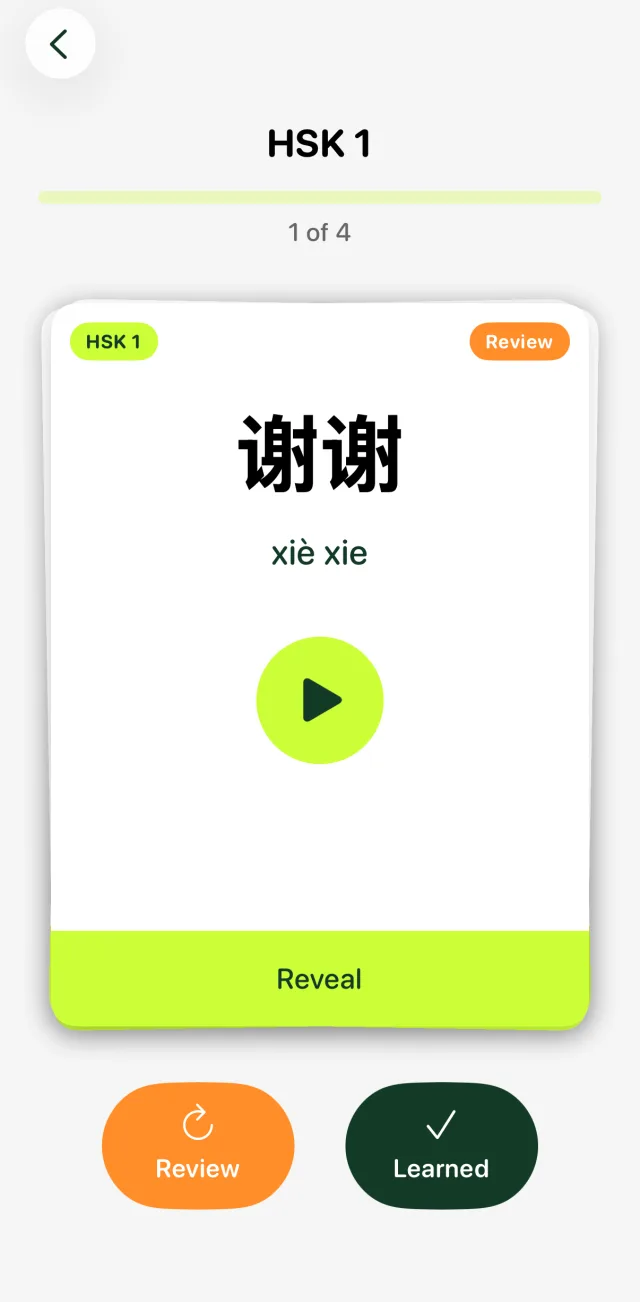
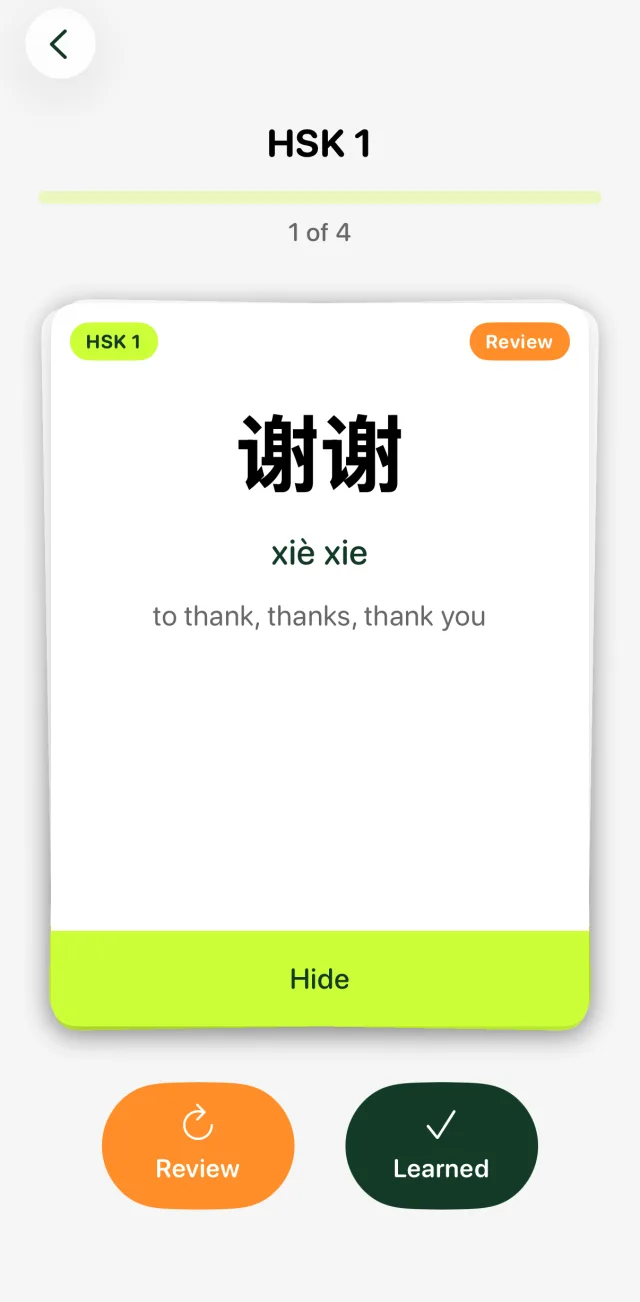
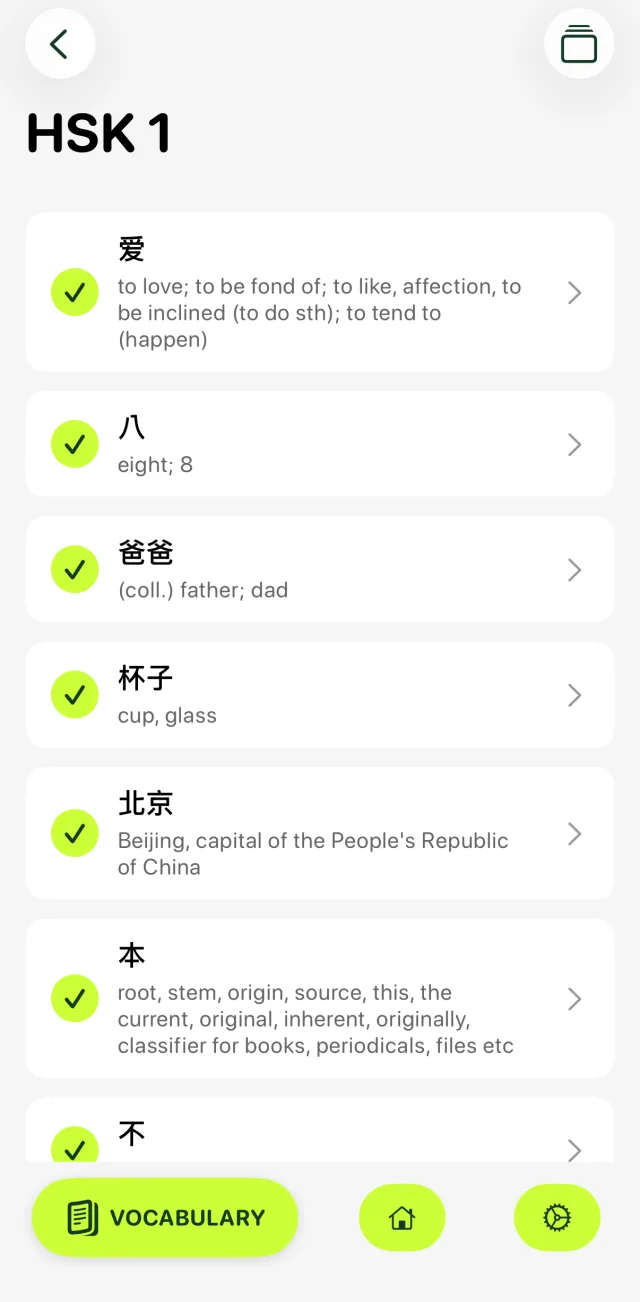
The HSK 1 word list shows which words you have learned and which you marked for review, so the review days in the plan are easy: open the Review pile and go through it. A daily streak helps with the "every day" part, and the app is free to start.

HSK Flashcard: learn Chinese vocabulary
Study the HSK 1 to 6 word lists with swipeable flashcards that show pinyin and meaning and read each word aloud. Review the words you mark, take quick quizzes, and keep a daily streak. Free to start.

FAQ
How many words are in HSK 1?
150 in the current HSK (HSK 2.0), per CTI's official list. The new HSK 3.0 level 1 has 300.
Is the HSK 1 vocabulary enough to have a conversation?
For very simple ones: greetings, numbers, prices, the date and time, and short questions such as 你叫什么名字? (nǐ jiào shénme míngzi, what's your name?). For everyday conversations you need more words. HSK 2 doubles the list to 300.
Do I need to learn the characters for HSK 1?
Learn to recognize them. CTI's 2010 HSK 1 syllabus says the questions on the HSK 1 paper also show pinyin, but the new HSK 3.0 level 1 lists 246 characters to recognize, and reading Chinese beyond the basics means reading characters. Learn the pinyin first to get the sound and tones right, then make sure you know each word by its characters too.
Where can I download the official HSK 1 word list?
CTI publishes it as an Excel file on chinesetest.cn. It has one sheet per level, in characters only. The tables above add the pinyin and meanings.